Ever wish you could live somewhere that feels grounded in history without giving up the ease of everyday routines? If you are curious about Paris, Kentucky, you are probably wondering what daily life actually looks like beyond the postcard version. This guide walks you through the pace, setting, housing, and day-to-day experience of living in historic Paris so you can picture what it might feel like to call it home. Let’s dive in.
Paris has a close-knit daily rhythm
Paris is a compact city with a small-town scale that shapes how life feels from one day to the next. The city had 10,171 residents in 2020 and an estimated 10,185 in 2024, all within 7.92 square miles of land.
That size matters in practical ways. Many of the places that shape your weekly routine, like downtown, city offices, and schools, are relatively close together. If you prefer a place where errands and local destinations do not feel spread across a huge metro area, Paris offers that tighter footprint.
Bourbon County as a whole is much larger geographically, with 289.75 square miles and about 20,333 residents. That means you can move quickly from city blocks to open countryside, which is a big part of the area’s identity.
Historic character shapes everyday life
Paris is often described by local sources as historic, spirited, and evolving. In everyday terms, that means you are not just living near a few preserved buildings. You are living in a place where history still influences the layout, look, and feel of town.
The downtown historic district is concentrated between Second and Fourth Streets from Main to High. This creates a core that feels defined and walkable, with historic storefronts, the courthouse square, and older architecture giving the area a strong sense of place.
Instead of a lifestyle centered on large commercial corridors, Paris tends to revolve around a traditional downtown pattern. Your day might include a quick stop on Main Street, an event near the courthouse, or a seasonal visit to a local market.
Downtown Paris is part of the routine
In many towns, downtown is more of a backdrop than a daily destination. In Paris, downtown still plays a real role in how people spend time, run errands, and gather for events.
Local tourism materials highlight routines like coffee and breakfast on Main Street, browsing boutiques, visiting the Welcome Center, and spending time at the Farmers’ Market at 720 High Street. That kind of downtown use gives the city an everyday texture that feels more personal and local.
Paris also has an official downtown entertainment district. The city says the district supports downtown businesses and allows participating customers to carry approved to-go drinks while strolling historic Main Street and attending outdoor events.
That does not mean Paris feels busy like a large entertainment hub. It means downtown has an active, social role that helps keep the historic core relevant to daily life.
Community events add seasonal energy
One of the clearest signs of everyday life in Paris is how much the community calendar matters. Public life here is shaped by recurring local events rather than major regional attractions or big-box retail destinations.
Official tourism sources highlight ARTWALK!, the Kentucky Strawberry Festival, the Paris Storytelling Festival, the annual Christmas Parade and tree lighting, and the Bourbon County Fair. These events help mark the year and create regular reasons for residents to spend time downtown and around the county.
If you like living in a place with visible seasons and familiar annual traditions, Paris offers that kind of rhythm. The result is a local lifestyle that feels connected to place and time, not just convenience.
Rural scenery is always close by
One of the most distinctive parts of living in Paris is how quickly the setting changes. You can be in the downtown core, then within a short drive find yourself surrounded by horse farms, fields, and Bluegrass scenery.
Tourism sources note that Bourbon County has more than 50 horse farms. That helps explain why the area feels so tied to horses and open land, even though the city itself remains compact.
This mix gives Paris a layered lifestyle. You get historic downtown moments in town, along with easy access to agritourism, parks, golf, and even a seasonal drive-in outside the core.
Commuting from Paris to Lexington
For many buyers, one of the biggest questions is whether Paris works as a home base for a regional commute. The answer is that it often can, especially if your work takes you toward Lexington or Fayette County.
The Kentucky Transportation Cabinet identifies US 27 and US 68 as the direct Paris Pike corridor connection. Its corridor plan describes the Lexington-to-Paris route as about 29 miles from Main Street in Lexington to the US 27 and US 68 split in Paris.
Census data adds useful context. The mean travel time to work is 24.0 minutes in Paris and 25.4 minutes in Bourbon County.
A county housing study also found that Fayette County was the top destination for Bourbon County residents commuting out of the county. More than 5,700 county residents commuted out for work in 2015, while nearly 4,000 commuters came into the county.
Taken together, those numbers suggest Paris functions as a Lexington-adjacent small city with a meaningful commuter population. If you want a smaller-town home base while staying connected to a larger job market, that is part of Paris’s appeal.
Housing in Paris offers variety
Paris does not present a one-note housing market. Instead, it offers a blend of older in-town homes, residential neighborhoods near downtown, and more typical county housing in suburban or rural settings.
Census QuickFacts shows an owner-occupied housing rate of 54.1% in the city and 63.7% in Bourbon County. Median owner-occupied home values are $186,300 in Paris and $229,300 countywide, while median gross rent is about $832 in the city and $822 in the county.
Those figures point to a market that remains largely residential and owner-occupied, while still including rental options. For buyers, that means you may find more than one path depending on whether you want historic character, a simpler suburban setup, or more space outside town.
Historic homes give Paris its identity
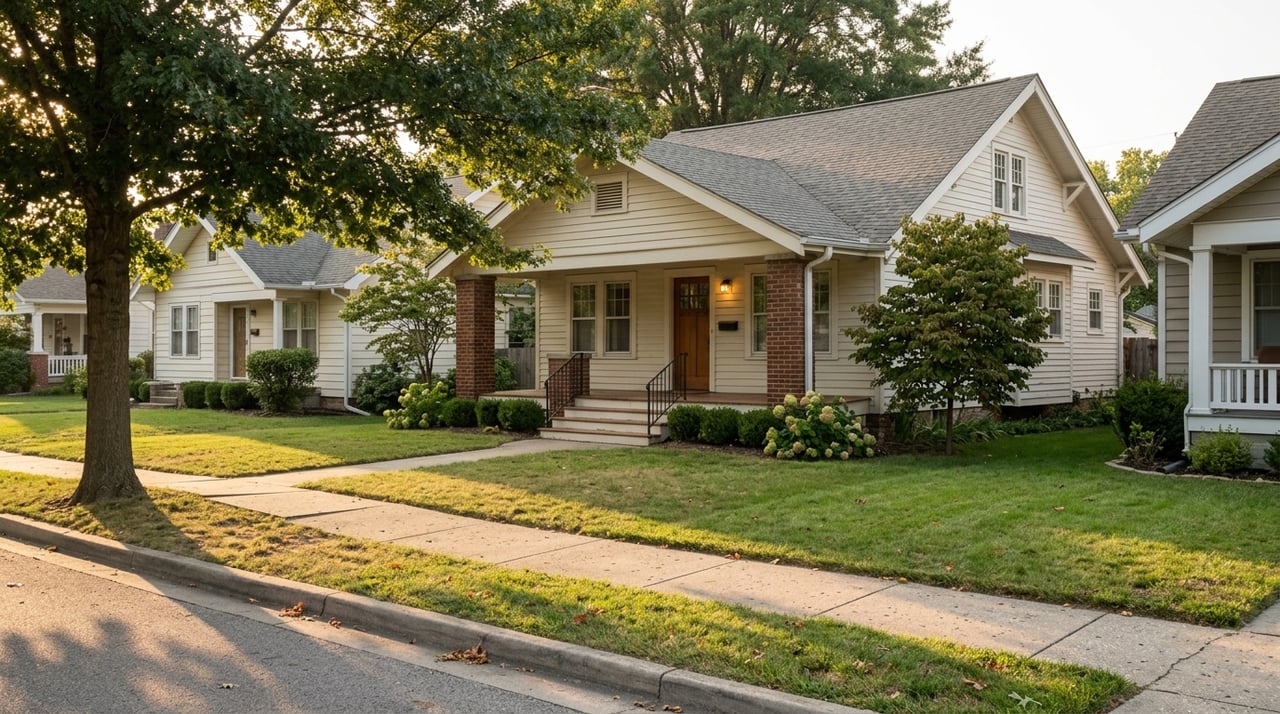
If you are drawn to older architecture, Paris stands out for the variety found in and around its historic core. The National Register nomination for Downtown Paris documents Greek Revival houses and townhouses, Queen Anne homes, Italianate houses, late Victorian commercial buildings, Colonial Revival and Classical Revival buildings, and later bungalows and semi-bungalows.
That range is one reason Paris feels layered rather than uniform. Streetscapes can shift from closely spaced homes to commercial blocks, and from one architectural style to another, without losing the town’s historic identity.
For some buyers, this is exactly the draw. You are not just buying square footage. You are buying into a setting with visible character and a stronger sense of place.
Living near downtown has real appeal
A county housing study found that more than 59% of respondents said they lived close to downtown Paris. That is a strong sign that the historic core still anchors everyday life.
The same study found that most surveyed residents lived in single-family homes, while townhouses were the second most common option. People considering a future move generally expected to buy rather than rent.
If you are comparing Paris with more spread-out markets, this matters. It suggests there is real demand for homes that keep you connected to downtown routines, community events, and the city’s central amenities.
Historic district ownership comes with extra considerations
Owning in a historic area can be rewarding, but it can also come with additional responsibilities. In Paris, the Board of Architectural Review oversees the City of Paris Historic District.
That means exterior changes within the district may require preservation review. If you love the idea of a historic home near downtown, it is smart to understand that the character you value may also come with a more formal process for visible alterations.
For many buyers, that tradeoff is worth it. You gain charm, walkability, and architectural detail, but you should go in with clear expectations.
What everyday life in Paris feels like
At its core, everyday life in historic Paris is about balance. You have a compact county seat with a defined downtown, regular community events, and historic architecture, but you are also surrounded by open land, horse farms, and easy regional connections.
That combination can be especially appealing if you want a place that feels local and manageable. Paris offers a pace that is car-oriented and practical, yet still tied to a walkable historic core and strong sense of identity.
If you are weighing a move, the biggest takeaway is simple. Paris is not trying to feel like a large city. Its appeal comes from being a smaller, historic Bluegrass community where daily life still centers on place, routine, and connection.
If you are exploring Kentucky markets and want clear guidance on how a community fits your goals, Sunday Property Group is here to help you make a confident next move.
FAQs
What is everyday life like in Paris, Kentucky?
- Everyday life in Paris, Kentucky, centers on a compact small-town layout, a historic downtown, community events, and quick access to surrounding countryside and horse-farm scenery.
How big is Paris, Kentucky?
- Paris had 10,171 residents in 2020 and an estimated 10,185 in 2024, with 7.92 square miles of land, making it a relatively compact city.
Is Paris, Kentucky, close to Lexington?
- Yes. Paris is closely tied to Lexington through the US 27 and US 68 corridor, and local commuting data shows many Bourbon County residents travel to Fayette County for work.
What kinds of homes are common in Paris, Kentucky?
- Paris includes a mix of historic single-family homes near downtown, other detached homes in suburban or rural settings, and some townhouse and rental options across the broader county.
What architectural styles are found in historic Paris, Kentucky?
- Historic Paris includes Greek Revival, Queen Anne, Italianate, late Victorian, Colonial Revival, Classical Revival, and bungalow-style buildings and homes.
Are there special rules for homes in the Paris historic district?
- Yes. Exterior changes within the City of Paris Historic District may be subject to review by the Board of Architectural Review.
Does downtown Paris, Kentucky, play a big role in daily life?
- Yes. Downtown remains a meaningful part of daily life, with shops, local gathering spaces, events, the courthouse area, and the Farmers’ Market helping anchor routine activity.
What makes Paris, Kentucky, different from a typical suburb?
- Paris offers a more historic, downtown-centered lifestyle with a compact layout and close access to rural Bluegrass scenery, rather than a pattern dominated by large commercial strips.